The Housing-Food Trade-Off in Vancouver: Understanding How Housing Costs Drive Food Insecurity

This policy brief draws on research from the 2025 study:

The Housing–Food Trade-Off in Vancouver: Understanding How Housing Costs Drive Food Insecurity

Author: Seth Oduro (UBC Master of Food and Resource Economics) Community partner: Vancouver Food Justice Coalition

Executive Summary

While food insecurity in Canada is often framed as a poverty issue, this research focuses on a critical but underexplored dynamic: the direct impact of extreme housing unaffordability on food security. This study posits that escalating housing costs increasingly absorb household resources in ways that compress residual income and force trade-offs in food consumption. Importantly, it suggests that food insecurity is not merely a function of low income, and should be addressed via a multi-pronged approach that integrates housing, food, and income policies simultaneously.

Introduction

Vancouver remains one of the most expensive housing markets in Canada and globally. The average rent for a one-bedroom apartment in 2025 exceeded $2,500 per month, while food costs have risen by more than 20% since 2020 (BC CDC, 2024). These combined pressures are stretching household budgets to a breaking point and reshaping how families allocate income, namely food spending, though there is a lack of research on the extent to which this impacts household food security.

Conducted in collaboration with the Vancouver Food Justice Coalition (VFJC) and the University of British Columbia’s Master of Food and Resource Economics (MFRE) program, this study directly addresses that gap by quantifying the relationship between housing and food expenditure. It hypothesizes that, in cities like Vancouver that are characterized by extreme housing unaffordability, housing costs constitute a more binding constraint on household food security than food price inflation or wage levels alone. We found that nearly half of participating households face both rent and food insecurity pressures.

Methodology

We conducted a 2025 survey of 115 low- and moderate-income households across Vancouver and analyzed the data using three key affordability metrics — Rent-to-Income Ratio (RIR), Food-to-Income Ratio (FIR), and Residual Income (RI) — to assess the trade-offs households make between rent and food consumption. Our analysis measures how rising rents compress household income and amplify food insecurity. By integrating quantitative evidence with policy interpretation, the research provides a new lens for understanding affordability as a linked housing-food system, not two separate challenges.

Results

Vancouver’s households face overlapping cost burdens that exceed traditional affordability benchmarks. Our findings show that housing costs do not directly cause food insecurity, but rather indirectly intensify it by constraining residual income. These results situate housing unaffordability as a key mechanism through which these broader inequities are translated into material food insecurity in high-cost urban contexts like Vancouver. As rent absorbs a growing share of household earnings, food becomes the primary adjustment margin, leading households to reduce food quantity, quality, and/or frequency in order to remain housed.

This dynamic helps explain why food insecurity may not always appear as elevated food spending, while coping behaviors such as meal skipping and reliance on food banks become increasingly normalized, even among middle- income households. Though it is not possible to make a direct correlation between costs of housing and food spending, the data make clear that housing affordability and food insecurity must be addressed jointly, not separately.

Key Findings

The survey results provide clear evidence of the housing–food affordability crisis in Vancouver. Across income levels and housing types, households are spending a disproportionate share of their income on rent and food, leaving little residual income for other essentials.

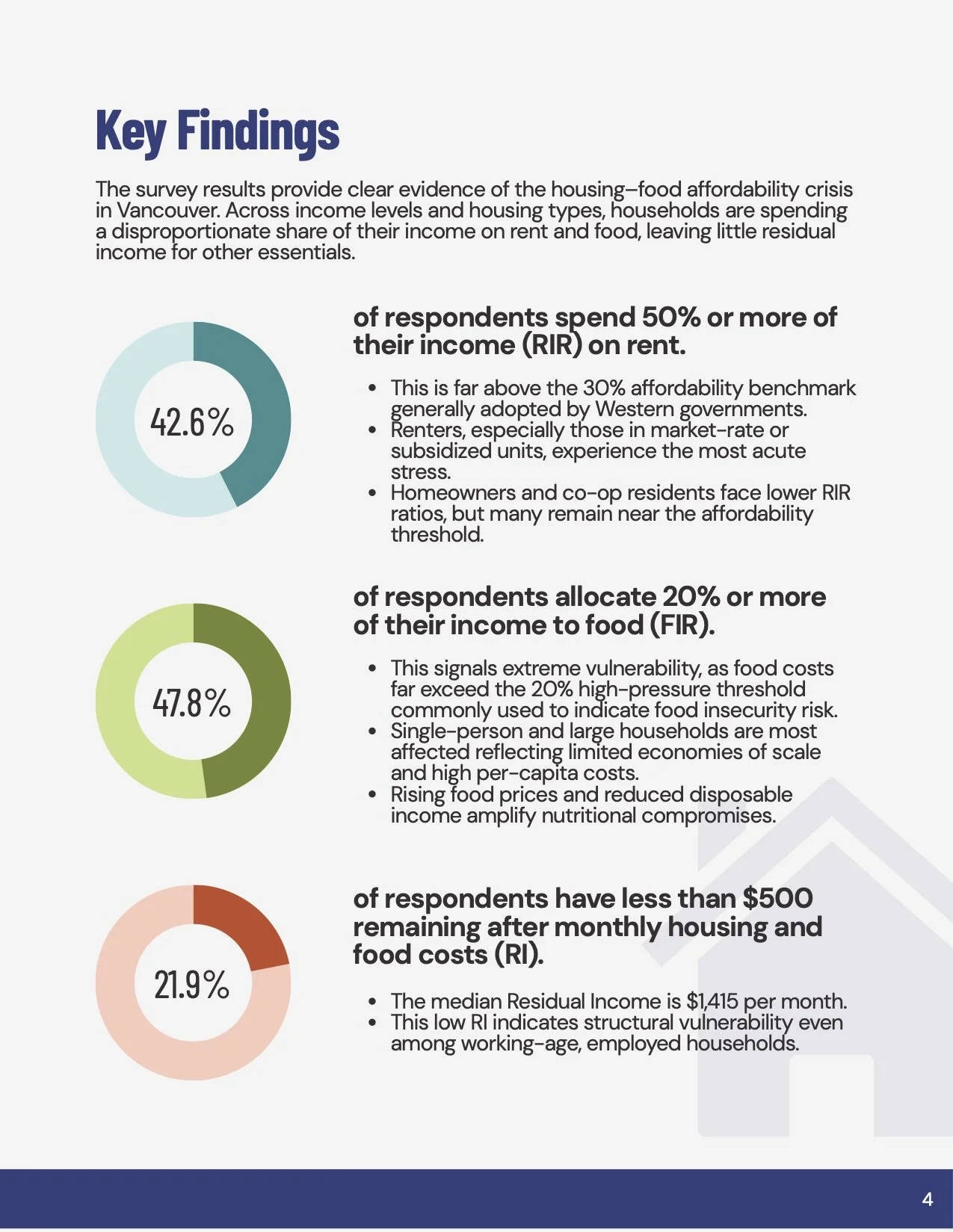
of respondents spend 50% or more of their income (RIR) on rent.

  • This is far above the 30% affordability benchmark generally adopted by Western governments.

  • Renters, especially those in market-rate or subsidized units, experience the most acute stress.

  • Homeowners and co-op residents face lower RIR ratios, but many remain near the affordability threshold.

of respondents allocate 20% or more of their income to food (FIR).

  • This signals extreme vulnerability, as food costs far exceed the 20% high-pressure threshold commonly used to indicate food insecurity risk.

  • Single-person and large households are most affected reflecting limited economies of scale and high per-capita costs.

  • Rising food prices and reduced disposable income amplify nutritional compromises.

of respondents have less than $500 remaining after monthly housing and food costs (RI).

  • The median Residual Income is $1,415 per month.

  • This low RI indicates structural vulnerability even among working-age, employed households.

Dual Burden Households

17–23% of respondents experience both high Rent-to-Income and Food-to- Income ratios.

  • These “dual-stress” households are predominantly renters and recipients of income-assistance programs.

  • This group represents the intersection of Vancouver’s housing crisis and food insecurity where cost pressures reinforce each other.

Coping Evidence

  • Households across all income brackets report adaptive behaviors to stretch budgets. This includes shopping at discount stores, buying near-expiry food, reducing meat/fresh food purchases, skipping meals, or relying on food banks.

  • Coping is no longer limited to low-income groups; it has become a normalized response to Vancouver’s high cost of living.


Policy Recommendations

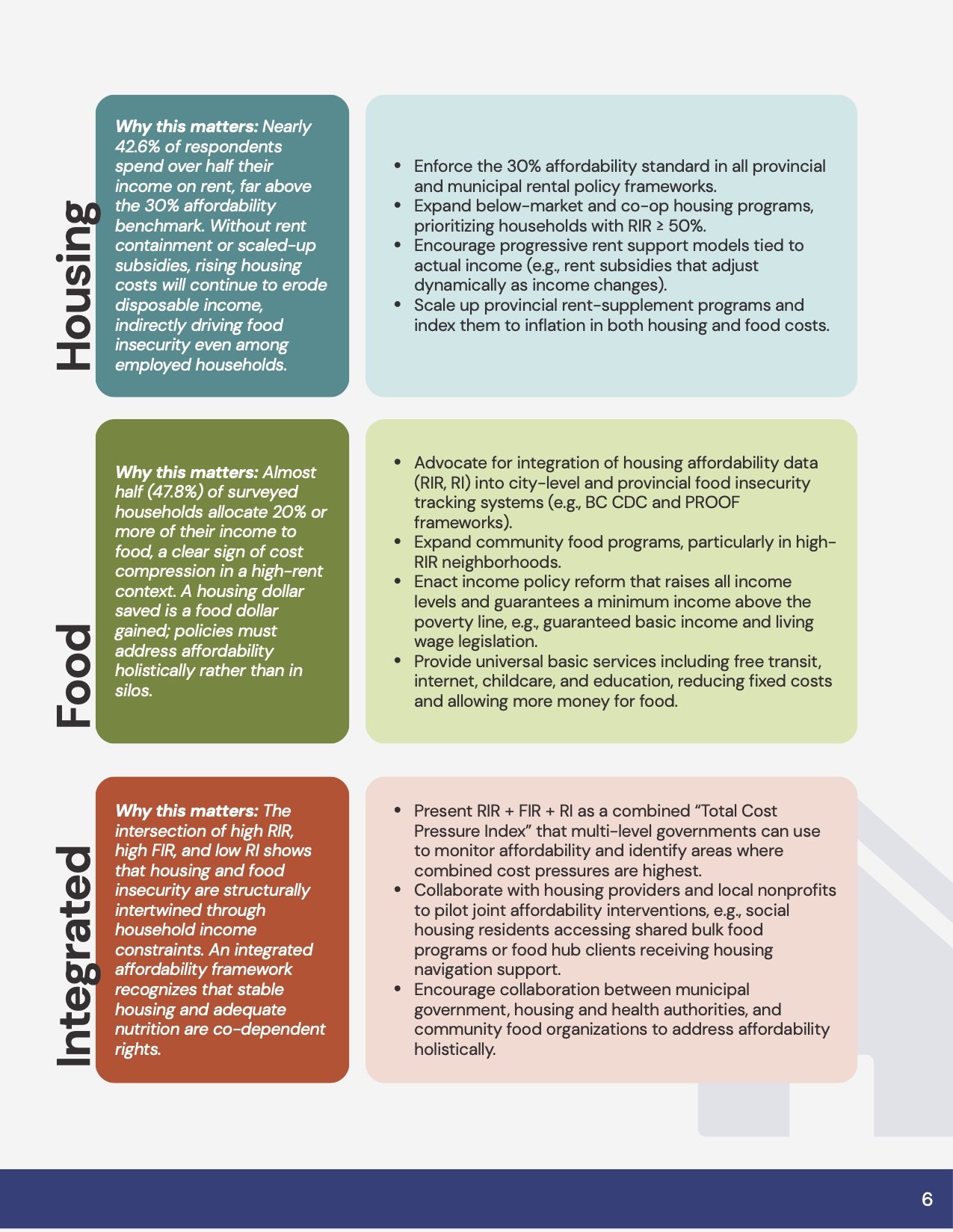
Together, the Rent-to-Income Ratio, Food-to-Income Ratio, Residual Income, and coping indicators reveal a structural affordability problem that justifies integrated policy reform across housing, food, and income systems.

The following page offers detailed strategies to address each of these policy frameworks holistically and collaboratively so that sectors inform one another rather than operate separately.

Call to Action

It is well known that the cost of housing in Vancouver is creating an affordability crisis, though it is no longer just a housing problem As evidence shows, housing affordability indirectly drives food insecurity by constraining the portion of income available for food and other essentials. Vancouver’s extreme rental market acts as a multiplier of financial stress: The result is a structural affordability trap, where high housing costs systematically erode food security, transforming cost-of-living pressure into material deprivation across income groups.

The housing crisis is in direct contradiction to human rights treatises where the right to housing requires access to affordable housing, and where housing costs are maintained to a level where “other basic needs are not threatened or compromised.” The right to housing fundamentally recognizes “the right to live somewhere in security, peace and dignity.” The right to adequate food necessitates that “every [person], alone or in community with others, has physical and economic access at all times to adequate food or means for its procurement.”

Tackling this dual burden requires collaboration across policy domains. A coordinated approach linking housing strategies, rent supports, and community food programs is essential to safeguard household well-being. This calls for joint planning between the City of Vancouver, BC Housing, Vancouver Coastal Health, community organizations and others to create integrated affordability solutions.

Through its community-based engagement, data-driven advocacy, and partnerships with UBC MFRE, the Vancouver Food Justice Coalition can help champion a citywide movement to monitor and address the housing–food nexus. By embedding affordability metrics into local policy dialogue and rights- based frameworks, the Vancouver Food Justice Coalition can help ensure that no household in Vancouver must choose between paying rent and eating well.

Next
Next

Big News out of Toronto - Toronto councillors approve city-run grocery store pilot project