
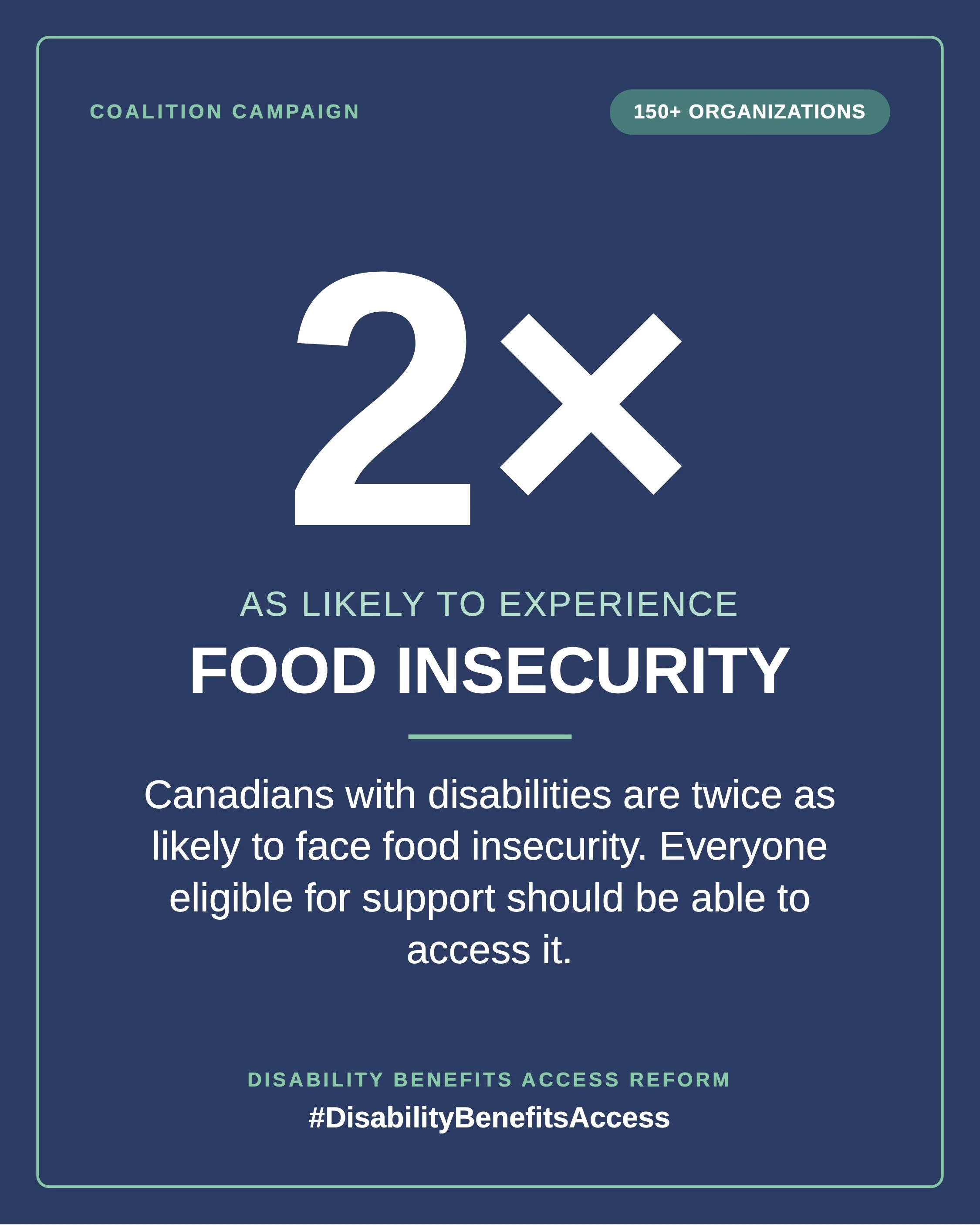
The Vancouver Food Justice Coalition is pleased to join 150 organizations from across Canada are calling on the federal government to establish a single, rights-based definition of disability and to change how people with disabilities qualify for federal supports.
The joint statement, released ahead of the upcoming federal budget, sets out two complementary paths:
A new rights-based system for defining disability, built outside the tax system.
Immediate fixes to the Disability Tax Credit (DTC).
These changes will make disability supports easier to access by removing administrative barriers and eliminating unnecessary red tape.
The DTC is a gateway to the Canada Disability Benefit and 16 other federal disability programs, plus a growing number of provincial and territorial programs. It was created nearly 40 years ago as a tax-relief measure and was never designed to be the eligibility test for all other disability supports.
Far too few eligible people access the DTC because of persistent administrative barriers.
Statistics Canada reports that fewer than one in six people with disabilities, and only about a third of people with very severe disabilities, in Canada access the DTC. This means hundreds of thousands of people with disabilities in Canada aren’t receiving the benefits they’re entitled to.
People with disabilities in Canada are also 50 per cent more likely to experience poverty than people without disabilities and twice as likely to experience food insecurity.
Failing to bridge these gaps means failing to uphold Canada’s responsibility to protect the fundamental human rights of people with disabilities.
The full Joint statement is reprinted here:
_________________________________________
Joint statement · October 27, 2026
We’re failing people with disabilities. A new approach could fix that.
Canadians with disabilities are fifty per cent more likely to experience poverty and twice as likely to experience food insecurity, yet hundreds of thousands of them are today denied access to government supports for which they are entitled and that would improve their lives.
Qualifying for the federal Disability Tax Credit (DTC) opens the door to receiving the Canada Disability Benefit and 16 other federal disability programs, as well as a growing number of provincial and territorial programs. But the DTC was never designed to be the de facto eligibility test for all other disability supports, and far too few eligible people are able to access it.
According to Statistics Canada, just 14.6 per cent of persons with disabilities and only 34.8 per cent of those with very severe disabilities claim the DTC.1
There are many reasons people do not or cannot claim the credit, including an overly restrictive definition of disability and persistent administrative barriers. This has serious and far-reaching consequences, excluding people with disabilities from the very programs intended to support their right to an adequate standard of living.
We applaud the federal government for making several recent administrative changes that improve access to the DTC. These are expected to unlock an estimated $345 million in support over six years for people facing access barriers. This is a solid foundation on which to build.
But there is much more to be done, and it will require fundamental reform.
We call on the federal government to commit to a collaborative process to design a new eligibility system that:
Uses the Accessible Canada Act’s definition of disability as the starting point for access to federal disability programs.
Creates a centralized disability status determination process outside the tax system that is dignified, accessible and rights-based.
Automatically extends federal disability certification to people already receiving disability benefits through provincial or territorial social assistance programs.
While a new eligibility system is created, we also call for further action to remove administrative barriers to the existing DTC process for people with disabilities and medical practitioners, including:
A new plain-language DTC application form, designed in collaboration with medical practitioners, that enables applicants to complete the functional assessment themselves and asks medical practitioners to certify accuracy.
Continued expansion of the list of medical practitioners authorized to fully certify disability for the DTC.
Direct reimbursement of medical practitioners who certify DTC applications, as already occurs with Canada Pension Plan disability benefit applications.
A plan to reduce the unnecessary use of temporary DTC certificates, along with a commitment to establish simplified renewal processes nationwide, building on the recent Manitoba pilot.
More flexibility in the interpretation of the phrase “all or substantially all of the time” when evaluating restrictions on daily living.
Allowing supported decision-making for DTC applications and administration.
Increased funding for the Disability Benefit Navigation program, which supports community-based organizations in helping people access the DTC, the Canada Disability Benefit, and provincial and territorial disability benefits.
All reforms must be designed in partnership with people with disabilities, in accordance with Canada’s human rights commitments under the UN Convention on the Rights of Persons with Disabilities. Central to the Convention is the principle of “nothing about us without us,” which affirms that people with disabilities must be meaningfully involved in decisions that affect them.
Canada should be a country where disability supports are available to all people with disabilities who need them, and no eligible recipient is denied access to a program because of administrative barriers. These reforms would bring that goal within reach.
Signed
ABLE2: Support for People with Disabilities; Access Alliance Multicultural Health and Community Services; AfroBiome Foods Incorporated; AIDS Committee of Durham Region (ACDR); Alliance for Equality of Blind Canadians / l’Alliance pour l’Égalité des Personnes Aveugles du Canada; Anglican Diocese of Toronto - Social Justice & Advocacy Committee; Annapolis Valley Community Food Council; ARCH Disability Law Centre; Association pour la santé environnementale du Québec; Autism Alliance of Canada; Barrier-Free Manitoba; BC Poverty Reduction Coalition; Blessing Home To Alleviate Poverty; Building Roots; Campaign 2000: End Child and Family Poverty; Canadian Centre for Caregiving Excellence; Canadian Centre for Policy Alternatives; Canadian Centre for Women Empowerment (CCFWE); Canadian Cultural Society of the Deaf; Canadian Down Syndrome Society; Canadian Medical Association; Carrefour solidaire centre communautaire d’alimentation; Centre d’éducation financière EBO (Entraide Budgétaire Ottawa); Centre for Spanish Speaking Peoples; Cerebral Palsy Association of Manitoba; Chalmers Community Services Centre; Community Advocacy & Legal Centre; Community and Legal Aid Services Program; Community Legal Clinic of York Region; Community Legal Services of Ottawa; Community Sector Council Newfoundland and Labrador; Confédération des organismes de personnes handicapées du Québec; Connections for Families Society; Council of Canadians with Disabilities; Daily Bread Food Bank; DAWN Canada; DBNC - Dixie Bloor Neighbourhood Centre; Debra Dynes Family House; Disability Alliance BC; Disability Justice Network of British Columbia; Disability Justice Network of Ontario; Disability Policy Research Program; Disability Without Poverty; Don Valley Community Legal Services; Downtown Legal Services; Dr Kingston Memorial Community Health Centre; DTES SRO Collaborative Society; Durham Community Legal Clinic; Elgin-Oxford Legal Clinic; End Homelessness Winnipeg; Ending Sexual Violence Association of Canada; Engel Research Lab (Finance & Disability stream), Rady Faculty of Health Sciences, University of Manitoba; Environmental Health Association of Canada; Family Service Toronto; Family Services of Greater Vancouver; Feed Nova Scotia; Feed Ontario; Food Bank On Wheels; Food Banks Canada; Food For All NB | Aliments pour tous NB; Food for Life; Food Stash Foundation; Grey-Bruce Community Legal Clinic; GTA Disability Coalition; Guelph & Wellington Poverty Elimination Collaborative; Hamilton Community Legal Clinic; Hamilton Roundtable for Poverty Reduction; HIV & AIDS Legal Clinic Ontario (HALCO); I Can for Kids Foundation; IAVGO Community Legal Clinic; Inclusion Alberta; Inclusion Canada; Inclusion Saskatchewan; Income Security Advocacy Centre; Indigenous Disability Canada; Indigenous Seniors Research Committee; Injured Workers Community Legal Clinic; Inner City Health Associates - Toronto IInnovation Youth/Christian Direction; John Howard Society of Prince Edward Island; Killaloe Community Resource Centre; Kinna-aweya Legal Clinic; Lake Country Community Legal Clinic; Launch Financial Education Society; Legal Clinic of Guelph and Wellington County; Lifetime Abilities; Little Mountain Neighbourhood House Society; LuckeLife Society; Manitoba Financial Empowerment Policy Committee; Manitoulin Legal Clinic; March of Dimes Canada; Maytree; Meals on Wheels PEI; Mindful Eats Ltd o/a Savor Living; Mississauga Community Legal Services; Momentum; Mount Paul Community Food Centre; National Association of Women and the Law; National Institute on Ageing; National Network for Mental Health; Neighbour to Neighbour Centre; Neighbourhood Legal Services; Neighbourhood Legal Services London and Middlesex; Nelson Community Food Centre; New Grocery Movement; New Westminster Homelessness Coalition Society; Niagara Community Legal Clinic; North York Harvest Food Bank; OCASI - Ontario Council of Agencies Serving Immigrants; ODSP Action Coalition; Ontario Disability Coalition; Parkdale Food Centre; Peterborough Community Legal Centre; Plan Institute; Portapique Market; Poverty Free Thunder Bay; Prospect Human Services; Prosper Canada; Race & Disability Canada; RESE (Retired Executives for Social Equity); Richmond Hill Mobility Accessibility Foundation; Right To Food; Righting Relations Canada; Scarborough Community Legal Services; SEED Winnipeg; Somali HelpAge Association Inc; South Etobicoke Community Legal Services; St. Michael’s Academic Family Health Team; Sudbury Community Service Centre; Sumac Community Food Centre; Table de concertation en sécurité alimentaire Gaspésie-Îles-de-la-Madeleine; Tamarack Institute for Community Engagement; The Depot Community Food Centre; The Link - Lakes District Family Enhancement Society; The Maple Leaf Centre for Food Security; The Neighbourhood Group Community Services; The North Grove; The Nourish and Develop Foundation; The Table Community Food Centre; Thunder Bay Counselling Centre; Toronto Neighbourhood Centres; Toronto People With AIDS Foundation; Vancouver Food Justice Coalition; Vancouver Neighbourhood Food Networks; Vibrant Communities Calgary; Waterloo Region Community Garden Network; Waterloo Region Community Legal Services; West Scarborough Community Legal Services; Willowdale Community Legal Services; Windsor-Essex Bilingual Legal Clinic; WoodGreen Community Services; Y.E.S. Manitoba; York Region Food Council; YWCA Toronto.
